By Propzine – Bengaluru’s Trusted PropTech Platform
The real estate outlook for November 2025 signals renewed optimism across India’s residential markets as post-Diwali sentiment strengthens buying activity. Historically, the November–January window has been the strongest sales quarter for developers, and early indicators this year suggest a similar trajectory. With festival-linked liquidity returning to equilibrium and homebuyer enquiries rising again, developers across Tier-1 cities are preparing for a busy end to the financial year.
Post-Diwali Property Sales Boost Market Confidence
The post-Diwali property sales cycle continues to remain a decisive growth driver, particularly for end-users in Bengaluru, Mumbai, Pune and NCR. As households settle into the festive financial reset—bonuses, improved cash flows, and renewed investment appetite—site visits and booking conversions accelerate meaningfully. This year, builders report that demand is strongest in mid-income and premium categories, supported by stable interest rates and wider availability of ready-to-move-in inventory.
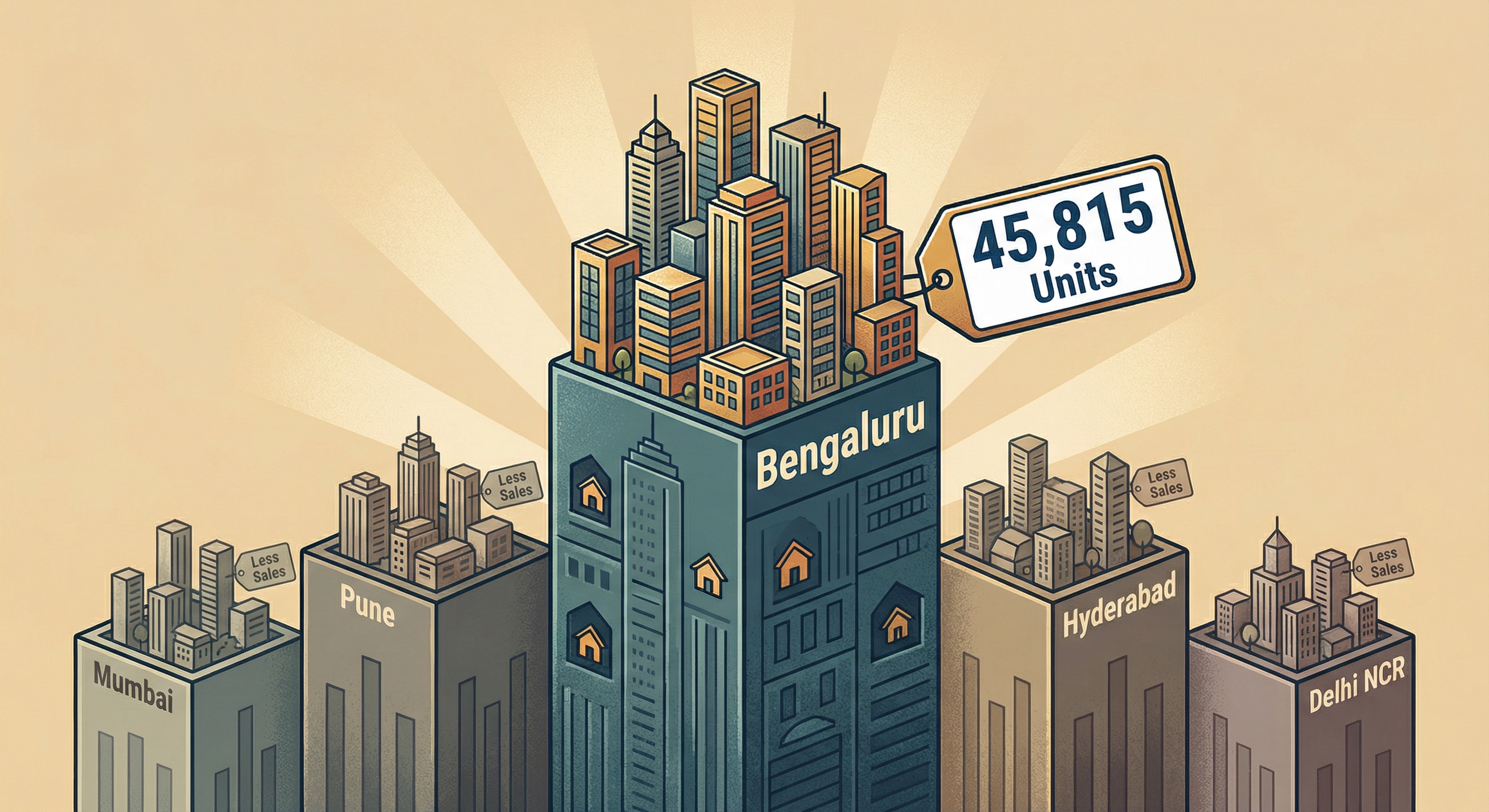
For Bengaluru homebuyers especially, the festival period has once again unlocked pent-up demand across East and South Bengaluru’s tech-driven corridors. This has reinforced Bengaluru’s position as the most resilient residential market in India heading into FY26.
Budget 2026 Expectations: Housing for All 2.0 to Re-Sharpen Government Focus
One of the major triggers shaping the real estate market forecast for India is the upcoming Union Budget, expected to formally introduce Housing for All 2.0. Unlike its predecessor, the new version is expected to focus heavily on expanding urban homeownership, accelerating last-mile infrastructure, and improving credit access for young families and first-time buyers.
Simultaneously, the government’s proposed Urban Infrastructure 2047 vision aims to create long-term frameworks for transit-oriented cities, integrated mobility, and sustainable housing ecosystems. For developers, clarity on reforms around taxation, faster approvals, and land monetization could significantly improve project viability in 2026.
State-Level Stamp Duty Reforms Strengthen Buyer Sentiment
Multiple states are evaluating targeted stamp duty reductions to stimulate demand in high-absorption micro-markets. These measures—especially in cities with rapidly rising property prices—help lower total acquisition costs and widen the base of first-time homebuyers. The anticipation of such reforms is already supporting buyer confidence in Q3 FY26, with developers in Mumbai, Pune, and Bengaluru reporting increased pre-booking interest.
For Bengaluru’s market, an alignment of lower stamp duty, continued IT hiring, and infrastructure expansions such as the Peripheral Ring Road (PRR) and metro corridor upgrades could further consolidate demand in 2026.
Stabilized Interest Rates Bring Predictability Back to Homebuyers
A major shift in the November 2025 real estate outlook is the stability in interest rates after two years of volatility. With inflation trending downward globally, banks have been able to maintain lending rates within a predictable band, allowing homebuyers to plan long-term EMIs with confidence. Developers are leveraging this stable environment by launching new phases of existing projects and offering structured payment-linked schemes tailored to end-user affordability.
Inventory Discipline & Better Project Execution Mark a New Cycle
This cycle is significantly different from the speculative boom years of the past. Developers are exercising better discipline—keeping unsold inventory under control, avoiding aggressive land banking, and ensuring stronger execution timelines. This operational maturity, combined with institutional financing and healthier balance sheets, has reduced market risk while increasing buyer trust.
Across Bengaluru, developers are focusing on timely delivery, customer transparency, and ecosystem-driven amenities—co-working spaces, EV-ready infrastructure, wellness zones, and smart home tech. As a Bengaluru-based proptech platform, Propzine continues to track these city-level trends closely, helping buyers and investors access verified market data and deeper project insights.
Why November–January Will Remain the Crucial Quarter for Developers
The strengthening end-of-year cycle reflects multiple demand drivers converging at once: stabilized home loan rates, improving sentiment, festive liquidity, policy optimism, and disciplined supply. Based on early traction, analysts expect the November–January period to contribute the largest share of sales in FY26, especially in high-demand cities like Bengaluru, where tech workforce stability continues to underpin sustained residential momentum.
Conclusion: A Promising Start to FY26 for India’s Housing Market
The real estate outlook for November 2025 paints a highly constructive picture for the sector as it enters a policy-heavy, sentiment-driven quarter. With reforms on the horizon, developers optimizing supply, and homebuyers returning with renewed confidence, India’s housing market is well-positioned for steady growth into FY26. For Bengaluru—India’s most dynamic residential hub—the coming months will be crucial in defining pricing trends, launch strategies, and buyer behavior for the next growth cycle.
As Propzine continues to bring real-time insights from India’s evolving proptech landscape, our analysis remains focused on helping homebuyers, investors, and developers navigate the shifts with data-backed clarity and accuracy.